The Meeting Audit: What Your Standing Meetings Cost and Which Ones to Cancel


Most standing meetings would fail an interview for their own slot. Someone booked them to get a launch out the door or calm a difficult client. The reason expired. The invite didn't, because nobody owns the question of whether it should still exist.
This article shows you how to price every standing meeting, test whether it still earns live time, and replace or retire the ones that don't.
TL;DR (Quick Summary)
Standing meetings survive because nobody reviews them with cost and output in view. The audit prices each one and tests whether it still needs live time. Meetings that pass stay. The rest get redesigned or replaced with lighter mechanisms that have an owner and a deadline, and every survivor gets a review date.
- Which meetings are on the table? → Every recurring series touching your team, pulled from everyone's calendar and costed on actual attendance
- What does each one cost? → Duration × attendees × loaded hourly rate, plus prep and follow-up, normalized to a monthly figure
- Does it deserve live time? → Only if it needs live discussion, has the right people at the right cadence, and reliably produces action
- Keep, redesign or cancel? → Pass all three tests and it stays; real need in a bad format gets redesigned; no live need and no action means it goes
- What replaces a cancelled meeting? → An async mechanism with an owner, a response-time target, a template and an escalation path
- How do you roll out the change? → The meeting owner announces exactly what changes, then a 30-day trial watches for stalled decisions and rebound meetings
- How do you stop the calendar refilling? → A quarterly review, trigger events for off-cycle checks, and an end date on every new series
Takeaway: A meeting that can't name its output, its cost and its next review date is running on inertia, and inertia is the most expensive attendee in the room.
Build a complete list of recurring meetings and the data needed to assess them
Pull every recurring meeting that touches your team over the next 8–12 weeks. That's a finite slice of the real calendar, and you can act on it.
Who runs it and how long it takes
One person owns the audit: the ops lead, or the manager whose team carries the meeting load. For a team of around 15, budget half a day to build the list and another half day chasing owners for missing details (an illustrative estimate; every team you share meetings with adds to it).
Run it in a quiet week. Mid-launch, you'll end up judging the launch meetings and missing the chronic ones.
Where to pull the list from
Your own calendar export only shows meetings you're invited to. Pull from each direct report's calendar too, or have everyone list their recurring invites. Count standing team meetings, project syncs, leadership reviews, cross-functional check-ins, office hours and any one-to-many session people are expected to attend. One-off sessions stay out.
Two kinds of meeting slip through most exports:
- Manual repeats: a "weekly" call someone recreates by hand every Friday, which no export flags as recurring
- Orphaned series: the organizer left or changed teams, and the invite keeps firing under their name
What to capture for each meeting
Record the basics for every meeting:
- Title and owner
- Frequency and duration
- Number invited and average actual attendance
- Required or optional attendance
- Whether prep or follow-up is routinely needed
Add a loaded hourly cost by role or salary band (the next section builds one). Rough internal bands are fine, as long as every meeting gets the same ones.
Accepted invites don't tell you who showed up. Check the last four instances against the video call's participant list, or ask the owner. Cost on actual attendance and keep the invite count in its own column, because a 12-person invite with 5 regulars is a finding on its own.
A simple register is enough:
|
Meeting |
Owner |
Cadence and length |
Invited / attending |
Prep / follow-up |
|---|---|---|---|---|
|
Product weekly sync |
PM lead |
Weekly, 30 min |
11 / 7 |
Yes / Yes |
|
Ops escalation review |
Operations manager |
Twice monthly, 45 min |
6 / 5 |
No / Yes |
That list alone surfaces duplicate forums and meetings nobody owns.
Calculate the real cost of each meeting, not just the time on the calendar
Price every meeting before anyone debates whether it's useful. Without a number, the audit turns into politics, and the most senior person's favorite meeting wins.
The formula
Two formulas cover it:
- Base cost = duration × actual attendees × hourly cost
- Real cost = (meeting time + prep time + follow-up time) × actual attendees × hourly cost, for any meeting that routinely needs prep or follow-up
"Loaded" means base pay plus everything else the business pays for that person. If you only have salaries, divide annual salary by 2,080 hours (40 hours × 52 weeks), then gross it up for benefits.
In June 2026, wages made up 70.0% of private-industry employer compensation costs and benefits the other 30.0%, according to the Bureau of Labor Statistics, so dividing an hourly wage by 0.7 gets you close to a loaded rate. For senior bands, check your numbers against the same release, which puts total employer cost for private-industry management, business and financial roles at $88.63 per hour worked.
Price mixed-seniority meetings by band. One flat average undercounts every meeting with a director in it. In a spreadsheet, put the bands in one column, attendees per band in the next and each band's hourly rate in a third, then use =SUMPRODUCT(attendees, rates) × duration in hours.
Normalize to a monthly figure
Short meetings get a free pass when you look at one instance at a time. Convert everything to a monthly cost:
- Weekly: × 4.33 (52 weeks ÷ 12)
- Biweekly: × 2.17
- Twice monthly: × 2
- Monthly: × 1
- Quarterly view: monthly cost × 3
An illustrative comparison: The weekly status has 7 attendees at $75 an hour. The monthly review has 5 attendees: two at $120 and three at $75.
|
Meeting |
Per instance |
Monthly |
Quarterly |
|---|---|---|---|
|
Weekly status, 30 min |
0.5 × 7 × $75 = $262.50 |
≈ $1,137 |
≈ $3,412 |
|
Prep for that status (3 people, 20 min) |
0.33 × 3 × $75 ≈ $75 |
≈ $325 |
≈ $975 |
|
Monthly review, 90 min |
1.5 × ($240 + $225) = $697.50 |
$697.50 |
≈ $2,093 |
The "quick" weekly status costs about 60% more a month than the 90-minute review with two senior people in it. Nobody had counted the prep line at all.
Opportunity cost
Beside the direct cost, flag these:
- The meeting splits a focus block in the middle of the morning or afternoon
- Senior people sit in status updates where their presence changes nothing
- People defer decisions until the next scheduled instance
Everyone quotes "it takes 23 minutes to refocus after an interruption." The figure traces to an interview in which researcher Gloria Mark described her fieldwork: people took an average of 23 minutes and 15 seconds to get back to interrupted work they resumed the same day. That interval included other tasks done before returning, so it measures how long work sits waiting, and some of that time went to useful work elsewhere. I still add a buffer for any meeting that splits a focus block: 15 minutes per attendee, as a working assumption.
The cheapest line in the sheet is often the one doing the most damage. A short weekly approvals slot looks like a rounding error until supplier quotes start expiring while requests wait a week for it. That meeting is a queue, and the fix is a different approval route.
Pro tip: Keep per-person rates in a locked tab and share only meeting totals. A cost sheet that lists rates by attendee lets anyone back out a colleague's salary in about a minute, and the audit loses all goodwill the moment that happens.
Run every standing meeting through three pass-fail tests
Cost tells you where to look. The tests tell you what to do, and a standing meeting keeps its current form only if it passes all three.
Test 1: Does this meeting produce an outcome that requires live discussion?
It passes if it regularly ends in a decision, a solved problem or a commitment that needed people talking in real time.
Live time earns its slot on tradeoff decisions, back-and-forth problem solving, disagreements and commitments from people who have to act together. Broadcast updates fail. So does a review of information people could have read, and so does "staying aligned" with no named decision attached.
Test 2: Are the right people in the room at the right cadence?
It passes if every regular attendee decides or contributes, and the cadence matches how often the underlying decisions arise.
If half the room is there out of caution or for visibility, the mix is wrong. Then check whether weekly reflects the work or just the invite's default setting.
Test 3: Is there evidence the meeting leads to action?
It passes if at least half of the last four to six instances produced a decision or an owned action with a date.
That threshold is a working rule rather than a published standard, and you can check it from notes or the task list in ten minutes. An agenda item that comes back three times unchanged fails the meeting on its own.

Who scores the tests
Owners grade their own meetings generously, so they don't score alone. Score each meeting with the owner, one regular attendee and whoever runs the audit, and give it five minutes. You're recording a verdict; nobody needs a defense brief for the calendar.
|
Meeting |
Live outcome needed? |
Right people/cadence? |
Leads to action? |
Pass/fail |
|---|---|---|---|---|
|
Weekly marketing status |
No |
No |
Weak |
Fail |
|
Biweekly incident review |
Yes |
Yes |
Yes |
Pass |
I once watched a team spend twenty minutes defending a weekly cross-functional sync as "where we stay aligned." Nobody in the room could name a decision it had made that quarter.
Meetings these tests don't fit
Some recurring meetings produce outputs the tests can't see:
- 1:1s, where the output is trust, early warning and coaching
- Client-facing calls, where the customer sets the cadence
- Meetings required by regulation, contract or your board
Leave these out of the cancel decision, but still review their length and attendance.
The whole audit is the wrong tool in two cases. If most of your load comes from one-off meetings and ad hoc calls, auditing recurring series won't touch it; look at how meetings get requested and who can send an invite. And a team of five sharing one standup doesn't need an audit at all. Ask them which meeting they'd drop, and drop it.

Decide whether to keep, redesign, or cancel each recurring meeting
Once a meeting has a cost and a test result, the decision is mechanical.
|
Test result |
Decision |
What usually changes |
|---|---|---|
|
Passes all three |
Keep |
Nothing, unless the cost is wildly out of line with the output |
|
Passes Test 1, fails Test 2 or 3 |
Redesign |
Attendees, cadence, length or agenda |
|
Fails Test 1, passes Test 3 |
Replace |
The live slot ends and its action-producing work moves to a written or tracked mechanism |
|
Fails Tests 1 and 3 |
Cancel |
The meeting ends and a replacement takes its job |
Expect most meetings to land in redesign. Useful forums bloat; very few stop being useful.
When Shopify wiped its recurring meetings in 2023, organizational psychologist Steven Rogelberg, author of The Surprising Science of Meetings, questioned the wholesale approach: the aim, he said, should be "to eliminate bad meetings and wasted time in meetings."
I'd argue for canceling a pure status meeting outright rather than shortening it. A 15-minute broadcast is still a broadcast, and it still breaks the focus block around it.
Redesign levers
For a meeting that still handles a real coordination problem, work through these before cancelling:
- Shorten it if discussion consistently finishes early
- Cut attendees to decision-makers and direct contributors
- Change the cadence to match the actual pace of work
- Move status updates to writing and keep live time for hard issues
- Make attendance role-based instead of inviting the same broad group every time
Role-based attendance does the most work. A recurring meeting can hold a seat for "engineering representative" or "regional ops lead" without booking the same individuals every week, and you rotate the seat or assign it by agenda.
One team I worked with cut its weekly sync from an hour to 15 minutes and kept the full invite list. It never once finished inside 15 minutes, and everyone kept blocking the hour.
Who signs off
The owner agrees the decision. Cross-team meetings need sign-off from every team that relies on them; cancel another team's coordination point on your own and the next audit gets no cooperation.
When a senior leader owns a failing meeting, take them the cost and the test result in private and ask them to propose the redesign. Numbers they can check land better than your recommendation.
Record the decision in one line
One line each, so nobody reopens the debate later. "Keep: weekly risk review, passes all tests, owner unchanged." "Redesign: project sync moves to biweekly, core attendees only, status moves to a written update." "Cancel: leadership update duplicates the dashboard and the written memo."
Pro tip: For a borderline meeting, cancel the next two instances with a one-line note and log every request that comes in because of it. Those requests are the meeting's real job description, and they tell you exactly what the replacement has to cover.
Replace cancelled meetings with lighter mechanisms that still keep work moving
A meeting doing real work, even badly, leaves a gap when it goes. Give every replacement operating rules, or the gap reopens within a month.
TechSmith, a 300-person software company, ran the extreme version in July 2022: a month with no meetings, with hiring interviews and vendor calls exempt. Each team needed a communications plan stating when, and whether, a reply was required. Meetings came back afterward, and the company's own report found the right number still varied widely by role.
Match the replacement to the job
The response targets below are examples to adjust, not benchmarks:
|
Old meeting job |
Replacement |
Owner |
Example target |
Escalation |
|---|---|---|---|---|
|
Status updates |
Written update |
Team lead |
Asks answered within 1 business day |
Unanswered ask goes to the lead |
|
Approvals |
Tracked approval queue |
Process owner |
Decision within 2 business days |
Approver's manager |
|
Routine coordination |
Shared board |
Each card's owner |
Status updated when work moves |
Raised in a remaining live meeting |
|
Announcements |
Channel post or recording |
Sender |
No reply needed |
None |
A status update template
A written update works when everyone fills in the same fields. Copy this:
Project: [name]
Owner: [name]
Period: [dates covered]
Status: [on track / at risk / blocked]
Changes since last update: [one to three lines]
Blockers and asks: [what's needed, from whom, by what date]
Next milestone: [what, and when]
Set the service level next to it. An example default: every item under "Blockers and asks" gets a reply within one business day, and anything older goes straight to the owner's lead. Skip this and the decisions that used to happen in the meeting stop happening anywhere.
Where Bitrix24 fits
Bitrix24 puts tasks, chat, shared calendars and video calls in one workspace, so a replacement and its record live in the same place. Task management gives every follow-up a responsible person and a deadline, and Kanban boards take over the routine coordination a status meeting used to cover. For a project that ran on a weekly sync, workgroups keep the project's people, tasks and conversation together.
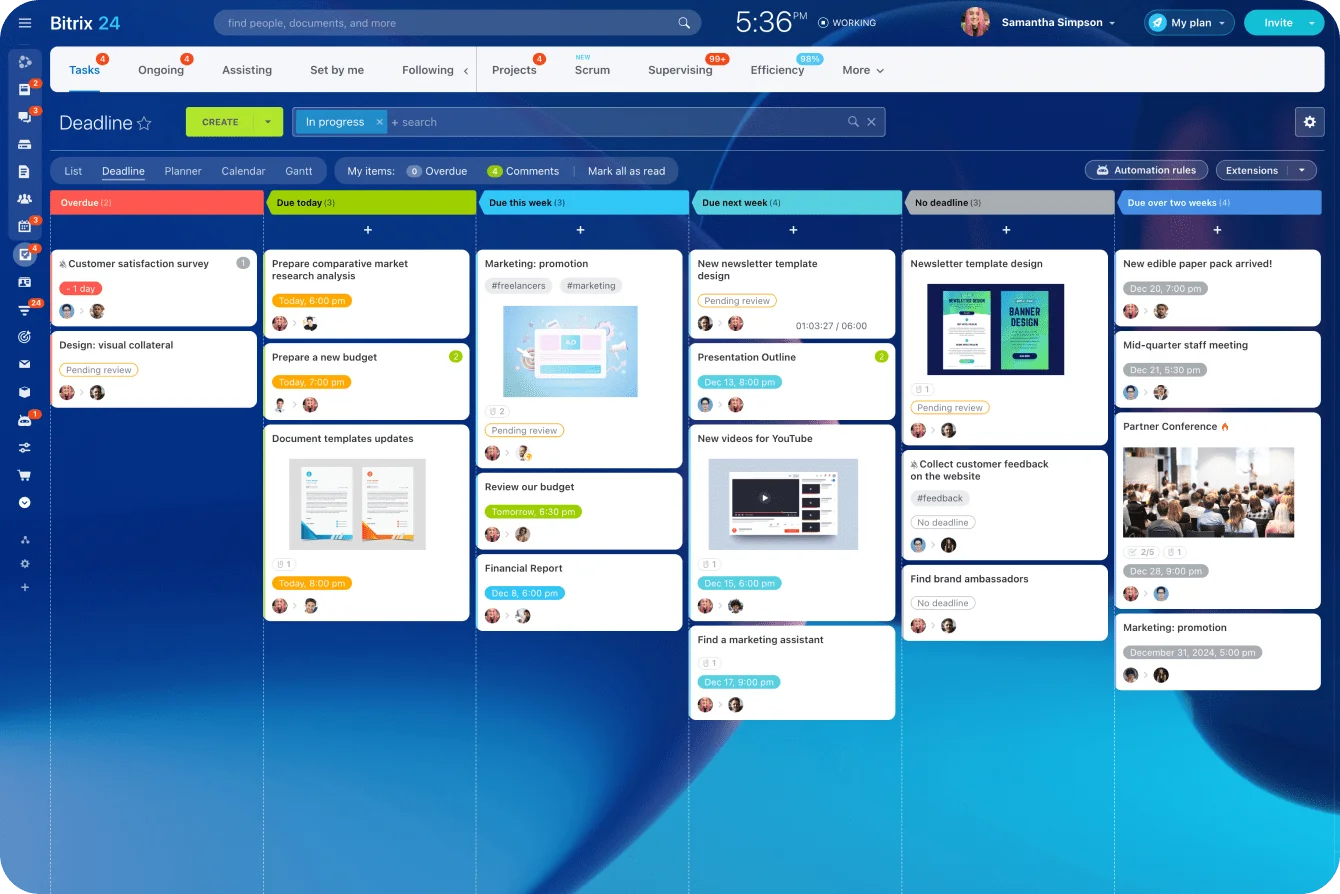
Kanban boards, Gantt charts, shared calendars, chat and video calls are all on the free plan. Task automation, which creates tasks and moves work along without someone chasing it, sits on the Professional tier. Bitrix24 is built as a working environment rather than a meeting-analytics tool, so the cost math stays in your spreadsheet.
Escalation is where replacements fail
Teams cancel a standup, move it to a channel and assume chat will carry the blockers. It looks fine for two weeks. Then a two-day blocker surfaces in a retro, and someone scrolls back to find it posted on day one, between two release notes.
Cross-team dependencies
A meeting can look inefficient and still be the only place two teams see each other's timing and risks. Cancel it only once the replacement shows those dependencies reliably. A Gantt chart with task dependencies shows when one team's slip moves another team's date, which is the one thing the sync was catching.
Communicate changes clearly and test the new meeting system for 30 days
The meeting owner announces each change a week before it takes effect, and the person who ran the audit stays out of it. People accept a change from the meeting's owner. From whoever ran the spreadsheet, it reads as a ruling.
"We're moving toward more async collaboration" gets treated as a slogan. Every note says what changes and what each attendee now does. A template for email or chat:
Subject: [Meeting name] is [ending / changing] from [date]
We're [ending / moving to biweekly / cutting to core attendees for] [meeting name].
Why: [one sentence: cost, purpose, cadence or output]
What replaces it: [mechanism, where it lives, owner]
Starts: [date]
What you need to do: [action, deadline, where to post]
Questions or problems during the first 30 days go to [name].
Run the 30-day trial
One person watches the redesigned and replaced meetings for 30 days. Their brief is to find friction early and fix it, including admitting part of the redesign was wrong. Check in at day 15; make the call at day 30.
Measure against your audit baseline:
- Hours booked in recurring meetings
- Time from an issue being raised to a decision on it, where a meeting was removed
- Missed handoffs, compared with the month before
- Attendee feedback on whether the new format is easier to maintain
- New ad hoc meetings on topics the old meeting covered
Watch for rebound meetings
Most trials miss the last signal on that list. A cancelled weekly sync comes back as three unscheduled calls on the same subject, booked by different people, each with half the right attendees. Recurring hours drop, total meeting hours don't, and the audit looks like a success on paper.
When decisions stall or rebound meetings show up, fix the mechanism. It might need a clearer template, a sharper escalation path, or a smaller live meeting in place of none.
Pro tip: During the trial, block the old meeting slot as focus time for everyone who used to attend. Leave it open and other meetings claim it before the trial ends, and the savings vanish from every calendar.
Set a recurring review cadence so cancelled meetings do not quietly return
Calendars refill. One audit buys you a couple of quarters before the old shape is back.
Review quarterly. Go monthly if you're scaling fast or run cross-functional groups that add meetings often. Each review asks the same question of every meeting on the register: what did it produce since last time?
Trigger an off-cycle review when
- Someone requests a new recurring meeting
- A reorg changes who needs to coordinate with whom
- Missed deadlines get blamed on coordination
- Key roles have calendars packed from morning to evening
A flood of new recurring invites means people are patching process gaps with calendar holds. Ask what process is missing before you approve the meeting.
End the audit, keep the register
Give the audit itself an end date. Without one, the audit becomes the standing meeting it was meant to question: a tracker someone updates every week long after the cuts have landed.
Run the audit as a project and keep the register as a light rule. A handful of fields per meeting, filled in once and checked quarterly, isn't a tracker anyone maintains week to week. One illustrative example:
|
Field |
Example |
|---|---|
|
Meeting |
Ops escalation review |
|
Owner |
Operations manager |
|
Purpose |
Decide on escalated customer issues that need two teams |
|
Expected output |
A decision and an owned action for each escalation |
|
Current format |
Twice monthly, 45 min, 5 core attendees |
|
Cost per month |
≈ $540 (illustrative) |
|
Next review date |
First week of next quarter |
New standing meetings fill in those fields before the invite goes out. Set every new series to end after 8 weeks by default (a house rule rather than a standard). Renewal takes one line from the owner saying what the meeting produced, and the meetings that can't supply that line expire without anyone missing them.
The review dates have to be real. In Bitrix24, the calendar sits in the same workspace as tasks, so each meeting's review can be a task assigned to its owner with a deadline.
Then watch the purpose field. Within a quarter, "alignment" and "visibility" start appearing as purposes, the register approves every request, and it becomes paperwork for creating meetings instead of checking them…
FAQ
Does this work for distributed teams across time zones?
Yes, and the payoff is bigger. A meeting that forces one region to join at 7 p.m. carries a cost the formula doesn't capture. Written updates with a clear response window replace those meetings more easily than they replace meetings in a single office.
What's a reasonable amount of meeting time per week?
That depends on the role. A coordinating manager rightly spends more time in meetings than an engineer who needs long focus blocks. Track hours booked by role in the register and set a target per role, with no single number for the whole team.
Cut meeting waste, keep work moving
Bitrix24 brings tasks, boards, chat, calendars and calls together so every decision has an owner, deadline and visible follow-through.
Get Started NowMake every standing meeting earn its renewal
A standing meeting is the one commitment in most businesses that renews itself without anyone signing for it. Subscriptions get questioned at renewal. The weekly sync just keeps billing, at the rates you calculated, until someone owns the question.
Three numbers from your own audit make that case to anyone who resists it:
- The monthly cost of the meetings that failed the tests
- The hours each role loses to them every week
- The decisions currently waiting for a scheduled instance
Bitrix24 keeps tasks, boards, chat and the calendar in one workspace, so the work a cancelled meeting carried lands with an owner and a deadline on day one.
Start for free and turn every surviving meeting’s review date into a task, assigned to its owner and due before the series renews itself.
Takeaway: The cheapest meeting to cancel is one that never became permanent, so give every new recurring invite an end date and make renewal the owner's job.